

Generative AI Projects: 10 Portfolio Ideas with Architecture
Ten Generative AI portfolio projects with architecture outlines, metrics and stretch goals, from a bilingual RAG bot to a vLLM load test and an eval suite.
Two freshers apply for the same GenAI role in Indore. The first lists "Chatbot using LangChain" and "PDF Q&A app". The second writes: "Hindi–English help-desk bot over 140 college circulars. Recall@5 of 0.91 on a 120-question test set, p95 latency 2.3 seconds, cost ₹0.04 per answer."
The interviewer asks the first candidate what went wrong while building. He is not sure. The second candidate talks for ten minutes about chunk sizes, a judge model that disagreed with her and a cache that halved her bill.
Projects are not about the topic. They are about evidence that you can build, measure and improve.
What makes a good Generative AI project?
A strong Generative AI portfolio project is a working application that solves one clearly defined problem on realistic data, documents its architecture, and reports measured quality, speed and cost, along with what you tried and what failed.
Recruiters skim. They look for four signals:
- A real problem and real data, not the same demo PDF everyone uses.
- An architecture diagram showing the pieces and how data flows.
- Numbers: an evaluation set, a metric, latency and cost.
- Engineering habits: tests, a clean repo, a demo, honest limitations.
The GenAI career roadmap explains which skills to learn in which order and describes three starter projects. The ten below go further, and many reuse ideas from the LLMOps lessons.
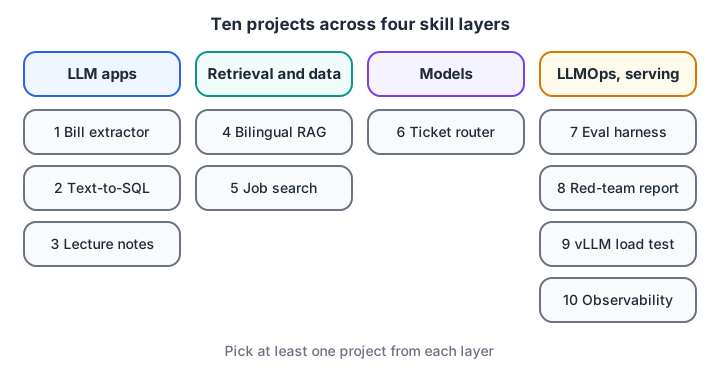
Pick at least one project from each layer. Together they tell a complete story.
LLM application projects
1. Structured data extractor for invoices and bills
Small shops and CA offices receive hundreds of GST bills as photos and PDFs. Build a tool that turns each into validated JSON: vendor, GSTIN, date, line items, tax and total.
upload -> OCR text -> LLM with JSON schema -> Pydantic validation
       -> if invalid: retry with error message -> save to SQLite -> CSV export
Measure: field-level accuracy on 50 hand-labelled bills, and how often validation needed a retry. Stretch: flag bills where line items do not add up to the total. Schema prompting is covered in structured output and JSON.
2. Text-to-SQL analytics assistant with guardrails
Let a shop owner ask "which product sold most in Diwali week?" in plain English. The model writes SQL, but code decides whether it may run.
question -> schema + examples in prompt -> LLM writes SQL
         -> guard: single SELECT, allowed tables, LIMIT added -> run read-only
         -> result table + chart + the SQL shown to the user
The guard is the part interviewers will ask about. Here is a minimal version you can extend.
import re, sqlite3

db = sqlite3.connect(":memory:")
db.executescript("""CREATE TABLE sales(product TEXT, qty INT, day TEXT);
INSERT INTO sales VALUES ('kaju katli',40,'2026-11-08'),('soan papdi',65,'2026-11-08'),
('kaju katli',55,'2026-11-09'),('besan laddoo',30,'2026-11-09');""")
ALLOWED = {"sales"}

def guard(sql):
    s = sql.strip().rstrip(";")
    if ";" in s or not re.match(r"(?is)^\s*select\b", s):
        return None, "only one SELECT statement allowed"
    if re.search(r"(?i)\b(insert|update|delete|drop|alter|attach|pragma)\b", s):
        return None, "write or admin keyword found"
    tables = set(t.lower() for t in re.findall(r"(?i)\b(?:from|join)\s+(\w+)", s))
    if not tables <= ALLOWED:
        return None, f"table not allowed: {tables - ALLOWED}"
    return (s if re.search(r"(?i)\blimit\b", s) else s + " LIMIT 100"), "ok"

for sql in ["SELECT product, SUM(qty) q FROM sales GROUP BY product ORDER BY q DESC",
            "DROP TABLE sales", "SELECT * FROM users"]:
    safe, why = guard(sql)
    print(why, "->", db.execute(safe).fetchall() if safe else "blocked")
Measure: execution accuracy on 40 questions with known answers. Stretch: run on a real database with a read-only user, the stronger guard.
3. Lecture notes summariser with a Gradio demo
Turn a two-hour recorded lecture transcript into chapter-wise notes and ten revision questions.
transcript -> split by time/topic -> summarise each chunk (map)
           -> merge summaries (reduce) -> notes + quiz -> Gradio app on Spaces
Measure: a rubric (coverage of key points, no invented facts) scored on five lectures by you and a classmate. Stretch: stream output and cite timestamps. See Gradio and Spaces.
Retrieval and data projects
4. Bilingual help-desk RAG bot with an evaluation report
Answer students' questions from a college's circulars and rules, in Hindi or English, with citations.
PDFs -> clean + chunk -> embeddings -> vector DB
query -> hybrid search (BM25 + vectors) -> re-rank top 20 -> LLM answer with [source]
offline: 120-question golden set -> recall@5, faithfulness, answer correctness
Measure: retrieval recall@5 and faithfulness, as in RAG evaluation. Stretch: compare two chunking strategies in a table.
5. Semantic job-search engine with a re-ranker
Search 5,000 job postings by meaning ("data role, fresher, Indore, no night shifts"), not keywords.
postings -> embeddings -> vector index + metadata filters (city, experience)
query -> retrieve 50 -> cross-encoder re-rank -> top 10 with "why this matched"
Measure: precision@10 on 30 queries you labelled. Stretch: add a hybrid keyword score and show which queries it fixes. Background in hybrid search and re-ranking.
Quick check
Which project description is strongest for a GenAI resume?
Specific data, a test set and measured results show you can build and evaluate, not just follow a tutorial.
Model and fine-tuning projects
6. Support-ticket router: prompting vs LoRA fine-tuning
Classify 3,000 synthetic or anonymised support tickets into eight queues. Compare a prompted model with a small model fine-tuned with LoRA.
tickets -> clean + label -> train/val/test split
A: few-shot prompt on a hosted model     B: LoRA on a small open model
both -> macro F1, latency, cost per 1,000 tickets -> comparison table
Measure: macro F1 and cost per 1,000 tickets for both. Stretch: error analysis of the five most confused queue pairs. See fine-tuning with LoRA.
LLMOps and serving projects
7. Evaluation and regression harness in CI
Build the test suite for any chatbot: a golden set, code rubrics, an LLM judge, and a GitHub Actions job that blocks merges when scores drop.
golden.jsonl -> run app -> exact match / F1 / rubric / judge (JSON verdicts)
judge calibration: 60 human labels -> Cohen's kappa
CI: compare with main branch -> fail if quality or safety drops
Measure: judge kappa against your labels, and one regression the harness caught. Uses LLM evaluation and LLM-as-a-judge.
8. Red-team report for an open-source chatbot
Pick an open-source chatbot or your own project 4, write a threat model, attack it, fix it, and publish the before/after attack success rates.
threat model -> seeds per category x strategies -> run attacks
-> detectors + judge -> ASR by category -> fixes in code -> rerun
Measure: attack success rate per category before and after. Stretch: add the attacks to project 7's CI. Method in red teaming LLM apps.
9. Self-hosted model on vLLM with a load-test report
Serve a small open model with vLLM on a rented GPU for a few hours, load-test it, and write up capacity and cost.
vllm serve <model> -> vllm bench serve at 1, 4, 8, 16 req/s
-> TTFT and TPOT p50/p95 -> requests per GPU-hour -> cost per 1,000 replies
compare: 16-bit vs quantised, prefix caching on vs off
Measure: the request rate at which p95 TTFT crosses one second. Guide: serving LLMs with vLLM.
10. Observability dashboard for an LLM app
Instrument project 4 with traces and build a dashboard: latency percentiles, cost per chat, thumbs-down rate by prompt version.
app -> OpenTelemetry spans (retrieve, chat, guardrails) -> mask PII
-> trace store -> dashboard: p50/p95, tokens, cost, feedback -> alert rules
Measure: find and fix one real slow-tail cause. See LLM observability.
How to combine projects into a capstone
Projects 4, 7, 9 and 10 fit together into one production-style system: a RAG bot, served on vLLM, tested in CI and traced in production. That single capstone shows the full LLMOps loop.
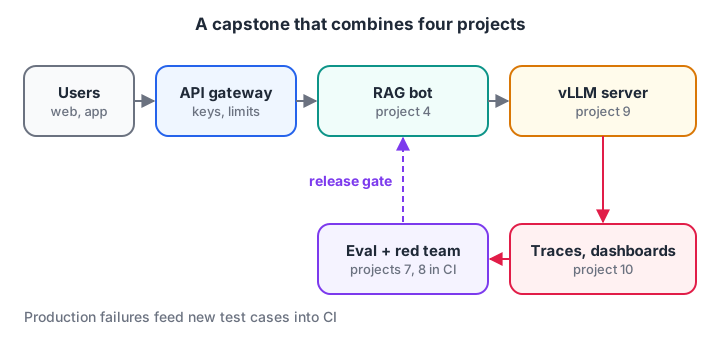
One system, four portfolio entries, and a story you can explain end to end in an interview.
How to present projects on GitHub
- Title and one-line problem statement at the top of the README.
- Architecture diagram and a short "how it works" list.
- Results table: metric, baseline, your system, and the test-set size.
- Demo: a hosted link or a 60-second screen recording.
- What failed and what you changed. This section starts the best interview conversations.
- How to run it, with a sample
.envand no real keys committed.
Common portfolio mistakes
- Tutorial clones. If your project matches a popular video step by step, it shows nothing new.
- No numbers. "Works well" is not a result. Report a metric on a test set.
- Committed API keys. Recruiters notice, and so do bots that scan GitHub.
- Ten shallow projects. Three deep ones with evaluation win.
- Naming hype instead of problems. Lead with the user and the outcome, not the framework.
Key takeaways
- Good projects solve a specific problem on real data and report quality, latency and cost.
- Cover four layers: applications, retrieval, models and LLMOps.
- Keep architecture outlines simple and put a diagram in every README.
- Combine RAG, evaluation, serving and observability into one capstone.
- Next, prepare to defend your work with Generative AI interview questions.
FAQ
Which Generative AI project is best for a fresher?
A RAG application over a real document set, with an evaluation report, is the best first project. It covers embeddings, retrieval, prompting and evaluation, which most GenAI roles use. Add one LLMOps project, such as an evaluation harness or observability dashboard, to stand out from candidates who only built chat demos.
How many projects do I need for a GenAI job?
Three or four well-documented projects are usually enough. Aim for one application, one retrieval system, one model-focused project such as fine-tuning, and one LLMOps or serving project. Depth matters more than count: each should have a test set, results table and a clear explanation of trade-offs you made.
Do I need a GPU to build Generative AI projects?
No. Most projects can use hosted model APIs or small models running on a laptop CPU. Only serving and fine-tuning projects need a GPU, and those can use a cloud GPU rented for a few hours or a free notebook GPU. Keep a budget and shut machines down after use.
Should I deploy my Generative AI projects?
Yes, at least one. A live demo or a hosted Gradio app lets recruiters try your work in a minute. For projects that are expensive to keep running, record a short video and include sample outputs in the README. Make sure keys are protected and usage is rate-limited.
Can I build these projects with guidance in Indore?
Yes. Debugshala in Old Palasia, Indore, runs a Generative AI course with project work and placement assistance, taught offline in English and Hindi. You can build a reviewed GenAI portfolio in Debugshala's Indore classroom after a free demo class. Solve SQL and Python coding rounds on Debugshala Test alongside.
From the team behind this site
Go further with the Generative AI Course at Debugshala
These tutorials are written by Debugshala, a training and placement institute at Old Palasia, Indore. The classroom course adds live mentoring, real projects and interview preparation.
- Offline classes at Old Palasia, Indore
- Free demo class before you pay
- Non-IT, fresher and year-gap friendly
- Placement assistance
700+ students placed · 200+ hiring partners · 4.9★ Google rating
