

CI/CD for Machine Learning: Tests, Quality Gates and Releases
CI/CD for machine learning: unit, data and behavioural tests, a quality gate against the champion model, a GitHub Actions workflow, canary release and CT.
At a good mithai shop before Diwali, nothing reaches the counter without the head halwai tasting it. A new batch of kaju katli is checked for sweetness, thickness and texture against the last good batch. If it is worse, it goes back, however nice it looks.
The check happens every batch, not once a season. And the counter staff never have to judge quality themselves; the taster's rule decides.
CI/CD for ML is that tasting rule, automated. Every change to code, data or settings produces a candidate model, and a fixed set of checks decides whether it reaches customers.
What is CI/CD for machine learning?
In the analogy, the new batch is a candidate model, the last good batch is the champion in production, the halwai's tasting is the quality gate, and sending it back is a failed pipeline that blocks the merge.
CI/CD for machine learning is the automation of building, testing and deploying ML systems, where continuous integration validates code, data and model quality on every change, and continuous delivery releases only the models that pass an agreed quality gate.
ML adds a third letter pair: CT, continuous training, which retrains models automatically when new data arrives or monitoring detects drift. This final lesson of the MLOps series wires together everything from what MLOps is onwards for Chappan Express, the fictional Indore delivery company, and its eta-model.
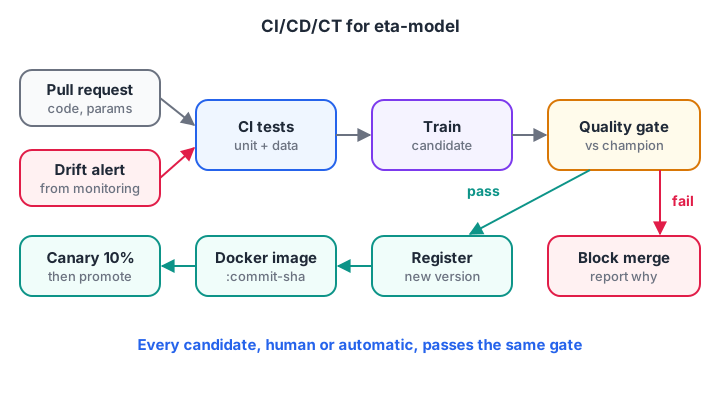
Code changes and drift alerts enter the same pipeline. Only the gate can promote a model.
CI vs CD vs CT in ML
| Continuous integration | Continuous delivery | Continuous training | |
|---|---|---|---|
| Triggered by | Pull request or push | A model passing the gate on main |
Schedule, new data or drift alert |
| Main job | Test code, data and model quality | Package, deploy, promote | Retrain on fresh data |
| Output | Pass or fail on the PR | A new version live (canary first) | A new candidate for the gate |
| Chappan Express example | PR adds a "rider load" feature | Image eta-api:15 rolled out at 10% |
Nightly retrain on yesterday's orders |
What should you test in an ML pipeline?
Ordinary software tests check that code does what it says. ML needs that plus checks on data and on learned behaviour.
- Unit tests for feature code. Units, time zones, defaults. These are fast and catch train/serve skew from the pipelines lesson.
- Data tests. Schema, null rates, ranges and row counts on the training snapshot.
- Model quality tests. Holdout MAE against the baseline and the champion.
- Slice tests. Quality on important groups such as rainy orders or one zone.
- Behavioural tests. Directional ("more distance, more minutes") and invariance ("order ID does not change the ETA") expectations.
- Serving tests. Latency, memory, and that the API returns valid JSON for good and bad inputs.
Unit tests for feature code
These look like any pytest file. The block runs them with a tiny runner so you can see the output in the browser; in a real repository you would put them in tests/test_features.py and run pytest.
def build_features(order):
    """Feature code shared by training and serving (from the pipelines lesson)."""
    hour_ist = (order["hour_utc"] + 5.5) % 24
    return {"distance_km": order["distance_m"] / 1000,
            "is_peak": int(int(hour_ist) in (13, 14, 20, 21)),
            "is_raining": int(bool(order.get("rain_mm", 0) > 0.5))}

def test_distance_in_km():
    assert build_features({"distance_m": 3200, "hour_utc": 9})["distance_km"] == 3.2

def test_peak_hour_uses_ist():
    assert build_features({"distance_m": 1, "hour_utc": 14.5})["is_peak"] == 1  # 8 pm IST

def test_missing_rain_defaults_to_dry():
    assert build_features({"distance_m": 1, "hour_utc": 3})["is_raining"] == 0

def test_drizzle_is_not_rain():
    assert build_features({"distance_m": 1, "hour_utc": 3, "rain_mm": 0.2})["is_raining"] == 0

tests = [f for name, f in dict(globals()).items() if name.startswith("test_")]
passed = 0
for t in tests:
    try:
        t(); passed += 1; print("PASSED", t.__name__)
    except AssertionError:
        print("FAILED", t.__name__)
print(f"\n{passed} passed, {len(tests) - passed} failed")
Each test pins down one decision that once caused a bug somewhere: metres versus kilometres, UTC versus IST, a missing field, a threshold. They run in milliseconds, so they run on every push.
Quick check
Which test checks that "a longer distance gives a longer ETA"?
Behavioural tests check learned behaviour against common-sense expectations, catching bugs that an overall error metric can hide.
Building a quality gate for a candidate model
The gate is the most important part of ML CI. It answers one question: should this model replace the one customers use today?
In this simulation, a pull request proposes switching eta-model from linear regression to gradient boosting. The gate trains the candidate, scores it on a fixed holdout set and runs six checks.
import time
import numpy as np
from sklearn.ensemble import GradientBoostingRegressor
from sklearn.linear_model import LinearRegression

rng = np.random.default_rng(30)
def orders(n):
    X = np.column_stack([rng.uniform(0.5, 9, n), rng.integers(8, 25, n), rng.integers(0, 2, n)])
    return X, 6 + 3.2 * X[:, 0] + X[:, 1] + 5 * X[:, 2] + 0.4 * X[:, 0] * X[:, 2] + rng.normal(0, 3, n)
X_tr, y_tr = orders(2500)
X_te, y_te = orders(800)                                    # fixed holdout set

champion = LinearRegression().fit(X_tr, y_tr)               # live eta-model:14
candidate = GradientBoostingRegressor(random_state=0).fit(X_tr, y_tr)  # PR's model
mae = lambda m, X, y: float(np.abs(y - m.predict(X)).mean())
rain = X_te[:, 2] == 1
t0 = time.perf_counter(); candidate.predict(X_te[:1]); ms = (time.perf_counter() - t0) * 1000

checks = {
    "schema: 3 numeric columns, no NaN": X_te.shape[1] == 3 and not np.isnan(X_te).any(),
    "beats baseline MAE (5.0 min)": mae(candidate, X_te, y_te) < 5.0,
    "not worse than champion": mae(candidate, X_te, y_te) <= mae(champion, X_te, y_te) * 1.02,
    "rainy slice MAE under 4.5": mae(candidate, X_te[rain], y_te[rain]) < 4.5,
    "longer distance -> longer ETA": candidate.predict([[8, 15, 0]])[0] > candidate.predict([[2, 15, 0]])[0],
    "single prediction under 50 ms": ms < 50,
}
print(f"champion MAE {mae(champion, X_te, y_te):.2f} | candidate MAE {mae(candidate, X_te, y_te):.2f}")
for name, ok in checks.items():
    print(("PASS " if ok else "FAIL ") + name)
print("\nGATE:", "promote candidate" if all(checks.values()) else "block merge")
The candidate passes almost everything, including the baseline, the rainy slice and the directional check. It still fails one rule: it is slightly worse than the simpler champion on the same holdout. The gate blocks the merge, and nobody had to argue about it in a meeting.
That is the point of agreeing the rules in advance. A fancier algorithm, a bigger feature set or a longer training run earns its place only by measurable improvement. The baseline and target values come from the very first decisions in the ML lifecycle.
Quick check
The candidate model beat the baseline but was 3% worse than the live champion. What should the gate do?
The baseline is a floor. The real comparison is against the champion, so a worse candidate is blocked.
A GitHub Actions workflow for ML
GitHub Actions is GitHub's built-in CI/CD service. Workflows are YAML files in .github/workflows/. This one runs tests and the gate on every pull request, and on main builds and pushes the image.
# .github/workflows/eta-model.yml
name: eta-model CI/CD

on:
  pull_request:
    paths: ["src/**", "tests/**", "params.yaml", "dvc.lock"]
  push:
    branches: [main]

jobs:
  test-and-gate:
    runs-on: ubuntu-latest
    steps:
      - uses: actions/checkout@v7
      - uses: actions/setup-python@v7
        with:
          python-version: "3.12"
          cache: pip
      - run: pip install -r requirements.txt
      - name: Unit and data tests
        run: pytest tests/ -q
      - name: Fetch versioned data
        run: dvc pull data/train.parquet data/holdout.parquet
        env:
          AWS_ACCESS_KEY_ID: ${{ secrets.AWS_ACCESS_KEY_ID }}
          AWS_SECRET_ACCESS_KEY: ${{ secrets.AWS_SECRET_ACCESS_KEY }}
      - name: Train candidate and run quality gate
        run: |
          python src/train.py --out models/candidate.joblib
          python src/gate.py --candidate models/candidate.joblib --champion-alias champion
        env:
          MLFLOW_TRACKING_URI: ${{ secrets.MLFLOW_TRACKING_URI }}

  build-and-release:
    needs: test-and-gate
    if: github.ref == 'refs/heads/main'
    runs-on: ubuntu-latest
    steps:
      - uses: actions/checkout@v7
      - name: Build and push image
        run: |
          echo "${{ secrets.REGISTRY_TOKEN }}" | docker login registry.example.com -u ci --password-stdin
          docker build -t registry.example.com/chappan/eta-api:${{ github.sha }} .
          docker push registry.example.com/chappan/eta-api:${{ github.sha }}
      - name: Start 10% canary
        run: ./deploy/canary.sh ${{ github.sha }}
A few details are worth noticing:
pathsfilter. Editing the README does not retrain a model.- Secrets. Credentials come from repository secrets, never from the code.
needsandif. Release runs only after the gate passes, and only onmain.- Image tag is the commit SHA, so every running container traces back to one commit, one data version and one model.
Action major versions change over time; check the GitHub Actions documentation and each action's release page when you copy a workflow. If you are new to the shell commands in the run: steps, they are the same ones from the Docker lesson.
Continuous delivery: canary, promote, roll back
Passing the gate on a holdout set is necessary, not sufficient. Live traffic is the real test. Chappan Express's delivery script follows these steps:
- Deploy
eta-apiwith the new image to a canary Deployment that takes 10% of traffic. - Watch latency, error rate and, once deliveries finish, live MAE for both versions for 24 to 48 hours.
- If the canary is at least as good, move the MLflow alias
championto the new version and roll it out to 100%. - If not, scale the canary to zero. Rollback is one command because the old image and model version still exist.
# Promote after a healthy canary
kubectl set image deployment/eta-api eta-api=registry.example.com/chappan/eta-api:3f9c1a7
kubectl rollout status deployment/eta-api

# Something wrong? Go back to the previous ReplicaSet
kubectl rollout undo deployment/eta-api
Continuous training: closing the loop
The last piece connects monitoring back to training. When the nightly job sees PSI above 0.25 on a key feature, or rolling MAE above target, it starts the training pipeline. The new candidate goes through exactly the same gate as a human's pull request.
That is the full MLOps loop from the first lesson, now automated: data, train, evaluate, deploy, monitor, retrain. Generative AI systems run the same loop with different tests, covered next in LLMOps explained.
Common mistakes in ML CI/CD
- Testing only code. Most ML failures are data or model failures.
- Comparing only to a baseline. A candidate can beat the baseline and still be worse than production.
- Random holdout sets per run. Scores then move with noise, and the gate flips between pass and fail.
- Automatic promotion without a canary. Holdout data never captures everything about live traffic.
- Retraining on a timer without a gate. A broken data day becomes a broken model in production.
- Slow pipelines. If CI takes two hours, people skip it. Sample data for PR checks; run full training on
main.
If you would like to build an end-to-end MLOps project with feedback, explore the generative AI track that Debugshala runs in Indore. For interview preparation, prepare for placement coding rounds on Debugshala Test.
Key takeaways
- ML CI/CD tests code, data and models, and adds continuous training to classic CI/CD.
- A quality gate with agreed rules decides promotion: baseline, champion, slices, behaviour and latency.
- Unit tests on feature code catch skew; behavioural tests catch silly models.
- GitHub Actions can run tests, pull DVC data, train, gate, build and push on every change.
- Release through a canary, promote by moving the registry alias, and keep rollback to one command.
FAQ
What is CI/CD in machine learning?
CI/CD in machine learning automates testing and deploying ML systems. Continuous integration runs code tests, data checks and model quality checks on every change. Continuous delivery packages approved models and deploys them safely, often as a canary. Continuous training adds automated retraining when data or drift requires it.
How is CI/CD for ML different from regular CI/CD?
Regular CI/CD tests and ships code. ML CI/CD must also version and test data, train models inside the pipeline, compare them with the production model through a quality gate, and monitor them after release. Retraining on new data becomes a normal trigger alongside code changes.
What tests should an ML pipeline have?
At minimum: unit tests for feature code, data validation on schema, nulls and ranges, model quality against a baseline and the live champion on a fixed holdout set, slice checks for important groups, behavioural tests for expected directions, and serving tests for latency and valid responses.
Can GitHub Actions train a machine learning model?
Yes, for small and medium models GitHub-hosted runners can train within the pipeline. For heavy training, the workflow usually starts a job on a cloud GPU, a Kubernetes cluster or a managed training service, waits for it, and then runs the quality gate on the result.
Where can I learn MLOps and CI/CD for ML in Indore?
Debugshala at Old Palasia, Indore, teaches Generative AI, Machine Learning and Data Engineering in offline classes in English and Hindi, with placement assistance. Freshers, non-IT graduates and learners with a gap year are welcome, and a free demo class is available. Contact +91-8982385539 or info@debugshala.com.
From the team behind this site
Go further with the Generative AI Course at Debugshala
These tutorials are written by Debugshala, a training and placement institute at Old Palasia, Indore. The classroom course adds live mentoring, real projects and interview preparation.
- Offline classes at Old Palasia, Indore
- Free demo class before you pay
- Non-IT, fresher and year-gap friendly
- Placement assistance
700+ students placed · 200+ hiring partners · 4.9★ Google rating
