

Generative AI Roadmap: Skills, Projects and Jobs for Freshers
A Generative AI roadmap for freshers: the skills to learn, a six-stage path, three portfolio projects (RAG, MCP, agent) and how to study GenAI in Indore.
Think about how most people in Indore learn to drive. Nobody starts on the AB Road at 6 pm. You begin in an empty ground near Lalbagh learning the clutch, then quiet lanes, then busier roads with a trainer beside you, and only then the evening rush.
Skip a stage and you either stall constantly or panic in traffic. Each stage also gives you something concrete: first you can move the car, then you can turn, then you can actually reach a destination.
A Generative AI career works the same way. People who jump straight to "build an autonomous agent" usually stall, because they never got comfortable with Python, APIs or how an LLM behaves. People who move in stages, with a real project at each one, end up job-ready.
What a Generative AI career actually looks like
Mapping the analogy: the empty ground is Python and programming basics, the quiet lanes are LLM fundamentals and prompting, busier roads are embeddings and RAG, and traffic is agents, tools, MCP and deployment. Your trainer is a mentor, a course or a community who spots mistakes before they become habits.
A Generative AI roadmap is a staged plan of skills and projects that takes you from programming basics to building, evaluating and deploying applications powered by large language models.
Most GenAI jobs today are about using models, not inventing them. Companies want people who can connect an LLM to their documents, tools and workflows, and make the result accurate, safe and affordable. Common role titles include:
- AI engineer / LLM application developer: builds chatbots, RAG systems, agents and integrations.
- Machine learning engineer: also works on fine-tuning, model serving and performance.
- Data scientist with GenAI skills: applies LLMs to analysis, text classification and automation.
- Full stack developer with AI features: adds LLM-powered features to web products.
- AI solutions or support roles: configures and evaluates AI tools for business teams.
Titles vary between companies, so read job descriptions for skills rather than names.
Generative AI skills you need, layer by layer
| Layer | Skills | Why it matters |
|---|---|---|
| Programming | Python, functions, dictionaries, files, virtual environments, Git | Every GenAI tool and SDK assumes this |
| Data and APIs | JSON, HTTP requests, REST APIs, pandas basics | LLMs are reached through APIs and return JSON |
| ML basics | Training vs testing, overfitting, evaluation metrics | Helps you judge model output honestly |
| LLM fundamentals | Tokens, context windows, temperature, hallucination | Explains cost, limits and failures |
| Prompting | Roles, few-shot, structured output, templates | The cheapest way to improve results |
| Retrieval | Embeddings, cosine similarity, chunking, vector search | Grounds answers in your data |
| Agents and tools | Tool calling, agent loops, MCP, guardrails | Lets AI take actions safely |
| Production | Evaluation sets, logging, FastAPI, Docker, cloud basics, cost control | Turns a demo into a product |
You do not need a maths degree to start. Linear algebra and probability become useful later, especially if you move toward fine-tuning or research.
A stage-by-stage Generative AI learning path
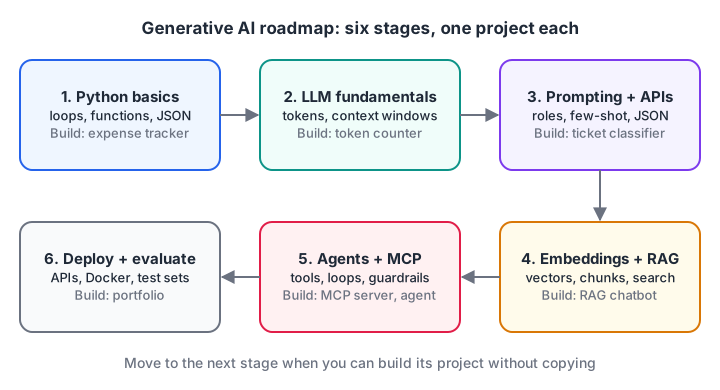
Six stages, each ending with something you can show. Move on when you can build the stage's mini-project without copying.
Stage 1: Python foundations. Variables, loops, conditionals, functions, lists and dictionaries, reading JSON. If you are new, start with Getting started with Python and the for loop tutorial. Mini-project: a command-line expense tracker.
Stage 2: LLM fundamentals. Understand tokens, next-token prediction, training vs inference, context windows and temperature. Read What is an LLM? and build its bigram model. Mini-project: a token and cost estimator for prompts.
Stage 3: Prompting and APIs. Call an LLM API from Python, design system prompts, use few-shot examples and parse JSON output safely. Work through the prompt engineering guide. Mini-project: a support-ticket classifier that returns validated JSON.
Stage 4: Embeddings and RAG. Learn vector similarity, chunking and retrieval, then combine them with prompting. Follow the embeddings tutorial, then What is RAG?. Mini-project: question answering over one PDF.
Stage 5: Agents and MCP. Learn tool calling, the ReAct loop, planning and guardrails, then expose your own tools through the Model Context Protocol. Read the AI agents tutorial and What is MCP?.
Stage 6: Deploy and evaluate. Wrap a project in an API, containerise it, log every request, build a test set and measure accuracy, latency and cost. This stage is what most beginner portfolios lack.
Generative AI projects that make a portfolio stand out
Recruiters see the same "chat with PDF" demo many times. What separates you is depth: evaluation, edge cases, clear documentation and honest limitations.
Project 1: a RAG chatbot over real documents
Pick a real document set, such as your university's ordinances, RTO rules or a product manual. Build chunking, retrieval and a grounded prompt with citations.
What makes it strong: a test set of 30 real questions, a measured retrieval hit rate, an "I don't know" path for unanswerable questions, and a short write-up of what failed and how you fixed it. Stretch goal: hybrid search plus a reranker.
Project 2: an MCP server for a useful tool
Build a server that exposes two or three tools, for example a timetable lookup, a library catalogue search or read-only queries over a small SQLite database. Connect it to an MCP-compatible host and show a screen recording of the assistant using it.
What makes it strong: clear tool descriptions, strict input schemas, read-only access by default, and a README section on security. This shows you understand how AI systems connect to the real world, which few freshers can demonstrate.
Project 3: a tool-using agent with guardrails
Build an agent that completes a multi-step task, such as researching three colleges from given data and producing a comparison table, or triaging emails into drafts. Use a step limit, a tool allowlist and human approval for any send action.
What makes it strong: logged traces of thought, action and observation, a success rate over ten test tasks, and a cost per task. Stretch goal: let the agent use the MCP server from Project 2.
Here is a small script to check where you stand. Edit the known set with skills you are confident in and run it:
roadmap = {
    "1 Python foundations":   ["loops", "functions", "dictionaries", "json"],
    "2 LLM fundamentals":     ["tokens", "context window", "temperature"],
    "3 Prompting and APIs":   ["system prompts", "few-shot", "structured output"],
    "4 Embeddings and RAG":   ["cosine similarity", "chunking", "retrieval"],
    "5 Agents and MCP":       ["tool calling", "agent loop", "mcp server"],
    "6 Deploy and evaluate":  ["test set", "api wrapper", "docker"],
}
known = {"loops", "functions", "dictionaries", "json", "tokens", "few-shot"}

for stage, skills in roadmap.items():
    done = [s for s in skills if s in known]
    bar = "#" * len(done) + "-" * (len(skills) - len(done))
    print(f"{stage:<24} [{bar}] {len(done)}/{len(skills)}")

for stage, skills in roadmap.items():
    missing = [s for s in skills if s not in known]
    if missing:
        print("\nFocus next on", stage, "->", ", ".join(missing))
        break
Quick check
Which project best shows you can connect AI to real tools safely?
An MCP server demonstrates tool design, schemas and security thinking, which employers value.
Quick check
What do most beginner GenAI portfolios lack?
Measured results separate a robust project from a demo that worked once.
How a classroom Generative AI course in Indore helps
Self-study works for many people, and every resource in this roadmap is free. A classroom course helps most if you want structure, deadlines and someone to review your code and projects as you go.
Debugshala is an industry-aligned training and placement institute in Indore focused on Data, AI and Full Stack Development. Its Generative AI course at the Old Palasia campus runs as offline classes, with teaching in English and Hindi. Here is what that means in practice:
- Who can join: fresh graduates, students from non-IT backgrounds and people with a year gap.
- Try before paying: there is a free demo class before you pay anything.
- Placement assistance is offered.
- Related tracks: Data Science & AI, Machine Learning, Data Analytics, BI Tools and Data Engineering are also offered, and some courses, such as Data Science & AI, are available online too.
- Practice: the Debugshala Test platform has aptitude, reasoning and coding quizzes for interview preparation.
The campus is at 204-208, C.S. Naidu Arcade, Greater Kailash Road, opposite Grotto, Old Palasia, Indore 452001. For admissions, call +91-8982385539 or email info@debugshala.com.
Common roadmap mistakes to avoid
- Collecting certificates instead of building. One deep, documented project beats five tutorial clones.
- Skipping Python. Weak basics make every later stage painful.
- Chasing every new model or framework. Concepts like retrieval, tool calling and evaluation outlast any single library.
- No evaluation in projects. "It works on my three questions" is not evidence. Show numbers.
- Hiding failures. Interviewers trust candidates who can explain what broke and why.
- Learning alone without feedback. Join a study group, a meetup or a course so someone reviews your work.
Key takeaways
- Most GenAI work is building reliable applications on LLMs, not training them.
- Learn in six stages: Python, LLM fundamentals, prompting, RAG, agents and MCP, deployment.
- Build a RAG chatbot, an MCP server and a guarded agent, each with evaluation.
- Depth, documentation and honest limitations beat a long list of shallow demos.
- If you want structure and feedback, a classroom course can speed up the journey; start with a free demo.
FAQ
Can a non-IT graduate build a career in Generative AI?
Yes. Many GenAI application roles need solid Python, clear thinking and good projects more than a computer science degree. Start at Stage 1 and do not rush it. Debugshala's courses accept non-IT graduates and people with a year gap, and you can sit in on a free demo class first.
Do I need a powerful GPU to learn Generative AI?
No. You can learn almost everything in this roadmap on an ordinary laptop, because LLMs are usually used through APIs, and embeddings for small projects run on a CPU. A GPU matters only when you train or fine-tune models yourself, and cloud notebooks can cover that when you get there.
Should I learn machine learning before Generative AI?
Learn the basics, not everything. Understanding training versus testing, overfitting and evaluation metrics helps you judge LLM output honestly. You can study deeper ML topics in parallel with GenAI projects rather than finishing them first.
Where can I learn Generative AI in Indore with placement support?
Debugshala offers a Generative AI course with offline classes at its Old Palasia campus in Indore, taught in English and Hindi, and placement assistance is offered. You can read the full Generative AI course details on Debugshala's site, or call +91-8982385539 to ask about the free demo class and the next batch.
From the team behind this site
Go further with the Generative AI Course at Debugshala
These tutorials are written by Debugshala, a training and placement institute at Old Palasia, Indore. The classroom course adds live mentoring, real projects and interview preparation.
- Offline classes at Old Palasia, Indore
- Free demo class before you pay
- Non-IT, fresher and year-gap friendly
- Placement assistance
700+ students placed · 200+ hiring partners · 4.9★ Google rating
